机械电子工程
Mechatronic Engineering
一、专业基本信息
I. Basic information
类型(Type):完全学分制
院系(Department):机电工程学院Mechatronic Engineering
专业(Major):机械电子工程Mechatronic Engineering
总学分(Total Credits):176
学科门类(Field of Study):工学Technology
专业类(Specialized Classification):机械类Mechanical
专业代码(Major Code):080204
授予学位(Degree):工学学士Bachelor of Engineering
学制(Years of Study):四年Four years
主干学科(Primary Discipline):机械工程Mechanical Engineering
相关学科(Related Discipline): 电子科学与技术Electronics Science and Technology , 计算机科学与技术Computer Science and Technology
大类名称(Specialty):智能制造类
专业概况(Introduction of Major):
历史沿革:专业源于1988年我校开设的“电子精密机械”专业,后经1993年、1998年、2013年三次教育部专业目录调整为“机械电子工程”专业,于1993年、2013年、2017年获批硕士、博士学位授予权和博士后流动站,2017年批准为国防特色学科。 特色优势。形成 “面向高端装备制造,注重工程实践,强化兵工精神”的人才培养特色。依托国防特色学科,复杂型面测量理论与技术达到国内先进水平,融合光学测量、传感器、机器人等新技术,形成了面向高端装备制造的特色;依托精密与超精密加工、测量等国家级平台,将工程项目与成果引入各教学环节,学生工程能力强;通过价值塑造与能力培养,将“忠诚进取、勇于奉献”为代表的兵工精神渗透到人才培养的各个环节中。
专业定位:遵循学校“为国防工业和区域经济服务”办学定位,培养具备高度社会责任感,在现代装备制造领域从事机电产品的研究开发、设计制造、运行管理等工作,具有良好人文素养、工程职业道德和较强创新能力的高素质人才,成为军工特色鲜明,区域领先的一流专业。
Historical Evolution The undergraduate major originated from the major of "Electronic Precision Machinery" established by our university in 1988. After three adjustments to the undergraduate major catalogue of the Ministry of education in 1993, 1998 and 2013, the major was renamed as "mechanical and electronic engineering". In 1993, 2013 and 2017, it was granted the right to grant master's and doctor's degrees and post-doctoral research center respectively. And it was approved as a characteristic discipline of national defense in 2017. Characteristic Advantages It has formed the personnel training characteristics of "Facing high-end equipment manufacturing, Paying attention to engineering practice and Strengthening ordnance industry spirit". Relying on the characteristic disciplines of national defense, the theory and technology of complex profile measurement have reached the domestic advanced level. Integrating new technologies such as optical measurement, sensors and robots, it has formed the characteristics for high-end equipment manufacturing. Relying on national project platforms such as precision and ultra precision machining and measurement, engineering projects and achievements are introduced into various teaching links, and students have strong engineering ability. Through value shaping and ability training, the ordnance industry spirit represented by "Loyalty and Enterprising, Brave in Dedication" is penetrated into all links of personnel training. Orientation of the Major Following our university’s running orientation of "serving the national defense industry and regional economy", cultivate senior engineering and technical personnels with a high sense of social responsibility, engaged in the research and development, design and manufacturing, operation management and other work of electromechanical products in the field of modern equipment manufacturing, with good humanistic quality, engineering professional ethics and strong innovation ability, so as to become the first class major with distinctive characteristics of ordnance industry and the regional leading.
二、培养目标
II.Educational Objectives
本专业面向国防工业和区域社会经济发展需求,培养德智体美劳全面发展,掌握解决机电领域复杂工程问题所需的数学与自然科学知识、工程知识及现代科学工具,能够在现代装备制造等相关领域从事机电产品的研究开发、设计制造、工程应用、运行管理等工作,具有正确社会主义核心价值观、高度社会责任感、良好人文素养、工程职业道德和较强创新能力的高素质人才。
学生毕业5年左右能达到:
(1)具有正确社会主义核心价值观,具有良好的人文科学素养,坚守职业道德规范,能够将实现个人价值与推动国家发展紧密结合并有能力服务社会。
(2)能够有效发掘工程问题,并综合运用数学与自然科学知识、工程知识及现代科学工具系统性解决机电领域复杂工程问题。
(3)能够创新性地进行自动化与智能化装备的规划与开发,在充分考虑环境、可持续性发展因素和社会综合影响下,承担相应的设计与制造、检测与控制、服务与管理等工作。
(4)能够不断适应机电产品自动化、智能化的国内外发展趋势,并在跨文化背景下进行有效的技术交流与团队协作。
(5)能够有效地持续学习和自我完善,具备工程师素质,并在相关领域的工作中形成职业竞争优势。
This major is oriented to the development demand of regional economy and national defense industry, aims to cultivate talents who have a high degree of social responsibility, can engage in the research and development, design and manufacturing, engineering application, operation management of electromechanical products in the field of modern equipment manufacturing, and has good humanistic qualities, engineering professional ethics and Senior engineering and technical personnel with strong innovation ability.
After 5 years of development after graduation, the following goals have been achieved:
(1) Have good humanities and science literacy, adhere to professional ethics, be able to closely integrate the realization of personal values with the promotion of national development, and have the willingness and ability to serve the society.
(2)could effectively discover engineering problems, and comprehensively use mathematics and natural science knowledge, engineering knowledge and modern scientific tools to systematically solve complex mechanical and electrical engineering problems.
(3)Be able to creatively plan and develop for automation and intelligent equipment, and undertake corresponding design and manufacturing, testing and control, service and management, taking full consideration of the environment, sustainable development factors, and comprehensive social influence.
(4)can continuously adapt to the domestic and foreign development trends of automation and intelligence of electromechanical products, and carry out effective technical exchanges and teamwork in a cross-cultural context.
(5)Be able to continue learning and self-improvement effectively, possess the quality of an engineer, and gradually form a professional competitive advantage in the work of related fields.
三、毕业要求
III.Program Outcomes
0、思想品德:具有坚定正确的政治方向,热爱祖国,热爱人民,拥护中国共产党的领导;具有正确的世界观、人生观、价值观,具有良好的思想品德、健全的人格、健康的体魄,践行社会主义核心价值观。
(0-1)具有坚定正确的政治方向,热爱祖国,热爱人民,拥护中国共产党的领导。
(0-2)具有正确的世界观、人生观、价值观,具有良好的思想品德、健全的人格、健康的体魄,践行社会主义核心价值观。
1、工程知识:具备解决机电领域复杂工程问题所需的数学、自然科学、计算、工程基础和专业知识,并将其应用于解决复杂工程问题。
(1-1)具有解决机电领域复杂工程问题所需的数学、自然科学、计算知识,并应用于复杂工程问题的建模和求解。
(1-2)具有解决机电领域复杂工程问题所需的工程基础知识,并应用于复杂工程问题的力、电、热等物理现象和材料特性的分析。
(1-3)具有解决机电领域复杂工程问题所需的专业基础知识,并应用于机电领域复杂工程问题中的设计与制造、测试与控制等问题的分析与解决。
(1-4)具有解决机电领域复杂工程问题所需的专业知识,并应用于机电领域复杂工程问题中的设计与生产。
2、问题分析:针对机电领域的机械、检测、控制等环节中的复杂工程问题,能够应用数学、自然科学和工程科学的基本原理进行有效识别、表达并通过文献研究分析,综合考虑可持续发展要求,以获得有效结论。
(2-1)能够应用工程科学的基本原理对机电领域的机械、检测、控制等环节中的复杂工程问题进行识别与判断。
(2-2)能够基于相关科学原理和数学模型方法对机电领域复杂工程问题进行分解、表达。
(2-3)能够认识到解决机电领域复杂工程问题有多种方案可选择,能通过文献研究寻求可替代的解决方案。
(2-4)能够应用基本原理,综合考虑可持续发展要求,对机电领域复杂工程问题进行研究、分析,并获得有效结论。
3、设计/开发解决方案:能够针对机电领域复杂工程问题设计与开发解决方案,设计满足特定需求的机械系统、测试系统、控制系统及单元等,体现创新性,并从健康、安全与环境、全生命周期成本与净零碳要求、法律与伦理、社会与文化等角度考虑可行性。
(3-1)掌握工程设计和产品开发全周期、全流程的基本设计方法和技术,能够设计针对机电领域复杂工程问题的解决方案。
(3-2)能够对方案进行可行性分析与论证,并考虑社会、健康、安全、净零碳、法律、文化及环境等制约因素。
(3-3)能够针对机电系统设计方案,设计满足特定需求的结构、动力、运动、感知和智能组成单元,并在设计环节中体现创新性。
(3-4)在综合考虑健康、安全、环境的条件下,能够设计满足特定需求的机械系统、测试系统、控制系统,并通过系统集成,设计出满足总体要求的机电系统。
4、研究:能够基于科学原理并采用科学方法对机电领域复杂工程问题进行研究,包括开展有针对性的调研、设计实验方案、搭建实验系统、分析与解释数据、并通过信息综合得到合理有效的结论。
(4-1)能够基于科学原理,通过文献研究和相关方法,调研和分析机电领域复杂工程问题的解决方案。
(4-2)能够采用科学方法对机电领域复杂工程问题的各类电、力、光、热等物理现象及系统特性选择研究路线,设计实验方案。
(4-3)能够根据实验方案构建实验系统,安全地开展实验,正确地采集实验数据。
(4-4)能够对实验结果进行分析和解释,通过信息综合得到合理有效的结论。
5、使用现代工具:能够针对机电领域复杂工程问题,开发、选择与使用恰当的技术、资源、现代工程工具和信息技术工具,包括对机电领域复杂工程问题的预测与模拟,并能够理解其局限性。
(5-1)了解机电领域复杂工程问题中常用专业现代仪器、信息技术工具、工程工具和模拟软件等的原理与方法,并理解其局限性。
(5-2)能够选择与使用恰当的专业现代仪器、信息技术工具、工程工具和模拟软件等,对机电领域复杂工程问题进行分析、计算与设计。
(5-3)能够针对机电领域具体的复杂工程问题对象,通过组合、选配、改进、二次开发等方式使用现代工具进行模拟和预测,满足特定需求,并能够分析其局限性。
6、工程与可持续发展:在解决机电领域复杂工程问题时,能够基于工程相关背景知识,分析和评价工程实践对健康、安全、环境、法律以及经济和社会可持续发展的影响,并理解应承担的责任。
(6-1)了解相关的技术标准、知识产权、产业政策和法律法规,理解不同社会文化对工程活动的影响。
(6-2)在解决机电领域复杂工程问题时,能认识、评价工程实践对社会、健康、安全、法律以及文化的影响,以及这些制约因素对项目实施的影响,并理解应承担的责任。
(6-3)理解经济和社会可持续发展战略内涵及其对机电工程实践的指导意义。
(6-4)能够站在经济和可持续发展的角度思考专业工程实践的可持续性,认识、评价机电产品全生命周期对人类产生的影响。
7、工程伦理和职业规范:有工程报国、为民造福的意识,具有人文社会科学素养和社会责任感,能够理解和践行工程伦理,在工程实践中遵守工程职业道德、规范和相关法律,履行责任。
(7-1)具有正确的价值观,具有人文社会科学素养和社会责任感,了解中国国情,具有工程报国、为民造福的情怀。
(7-2)理解和践行工程伦理,并能在工程实践中自觉遵守工程职业道德、规范和相关法律。
(7-3)理解工程师对公众的安全、健康和福祉以及环境保护的社会责任,能够在工程实践中自觉履行责任。
8、个人和团队:能够在机械、电子、控制及计算机等多样化、交叉学科背景下的团队中承担个体、团队成员以及负责人的角色。
(8-1)能理解个人在团队中的角色和责任,能与团队成员有效沟通,合作共事。
(8-2)能够承担多样化、多学科背景下的负责人、团队成员及个体的角色,合作、独立及组织协调开展工作。
9、沟通:能够就机电领域复杂工程问题与业界同行及社会公众进行有效沟通和交流,包括撰写报告和设计文稿、陈述发言、清晰表达或回应指令。能够在跨文化背景下进行沟通和交流,理解、尊重语言和文化差异。
(9-1)能够运用报告、图纸、设计文件等技术语言,通过书面或口头方式,就机电领域复杂工程问题与业界同行及社会公众进行有效沟通,并理解与业界同行和社会公众交流的差异性。
(9-2)了解专业领域的国际发展趋势、研究热点,理解和尊重世界不同文化的差异性和多样性。
(9-3)具有跨文化交流的语言和书面表达能力,能就专业问题在跨文化背景下进行基本沟通和交流。
10、项目管理:理解并掌握机电工程实践中工程管理原理与经济决策方法,并应用于多学科环境下的机电系统开发、设计、生产及改进中。
(10-1)理解机电工程实践中涉及的管理与经济决策方法,会对工程及产品全周期、全流程的成本构成进行分析。
(10-2)能够在多学科环境下,将工程管理与经济决策的基本方法应用于机电系统的开发、设计、生产及改进中。
11、终身学习:具有自主学习、终身学习和批判性思维的意识和能力,能够理解广泛的技术变革对工程和社会的影响,有适应新技术发展的能力。
(11-1)能够通过信息综合独立地归纳、批判和总结问题,判断先验的局限性。
(11-2)能够跟踪机电工程及相关学科的发展趋势,具有不断自主学习和适应新技术、新产业、新业态、新模式发展的能力。
0、Ideological and moral character: have firm and correct political direction, love motherland, love people, and support the leadership of the Communist Party of China; It has correct world outlook, outlook on life and values, good ideological and moral character, sound personality and healthy body, and implements the core socialist values.
(0-1)Has firm and correct political direction, love motherland, love people, and support the leadership of the Communist Party of China.
(0-2)Has correct world outlook, outlook on life and values, good ideological and moral character, sound personality and healthy body, and implements the core socialist values.
1、Engineering knowledge: possess ability of the mathematics, natural science, engineering foundation and professional knowledge required to solve complex electromechanical engineering problems, and apply it to the modeling and solving of complex engineering problems.
(1-1)Possess mathematical, natural scientific and computational knowledge necessary for resolving complex engineering problems in electromechanical field, and apply such knowledge to the modeling and solution of complex engineering problems.
(1-2)Possess the fundamental engineering knowledge required to solve complex engineering problems in the electromechanical field, and apply such knowledge to analyze physical phenomena (mechanics, electricity, heat, etc.) and material properties involved in complex engineering problems.
(1-3)Possess the basic professional knowledge required to solve complex engineering problems in the electromechanical field, and apply such knowledge to analyze and resolve issues including design & manufacturing, testing & control arising from complex electromechanical engineering problems.
(1-4)Possess the professional knowledge required to solve complex engineering problems in the electromechanical field, and apply such knowledge to the design and production of complex electromechanical engineering problems.
2、Problem analysis: For complex engineering problems arising from mechanical, inspection, control and other links in the electromechanical field, able to apply fundamental principles of mathematics, natural sciences and engineering sciences to effectively identify and formulate such problems, conduct analyses through literature research, and take sustainable development requirements into comprehensive consideration so as to draw valid conclusions.
(2-1)For complex engineering problems in the mechanical, detection, and control links of the electromechanical system can be effectively identification and judgment.
(2-2)For complex engineering problems in the mechanical, detection, and control links of the electromechanical system can be decomposition and expression.
(2-3)Effective conclusions can be obtained through literature research and analysis.
(2-4)Be able to apply fundamental principles, take sustainable development requirements into comprehensive consideration, conduct research and analysis on complex engineering problems in the electromechanical field, and reach valid conclusions.
3、Design/development solutions projects: be able to design and develop solutions to complex engineering problems in the electromechanical field; able to design mechanical systems, test systems, control systems and their units that meet specific requirements with innovative features. The feasibility of such designs shall be evaluated from multiple perspectives including health, safety and environment, whole-life cycle cost and net-zero carbon targets, legal and ethical norms, as well as social and cultural factors.
(3-1)Be able to apply the basic methods of full-cycle and full-process design of electromechanical products to design solutions to complex electromechanical engineering problems.
(3-2)Be able to analysis and demonstration mechanical systems, test systems, control systems, etc. considering social, health, safety, legal, cultural and environmental factors.
(3-3)Be able to design mechanical systems, test systems, control systems, etc. use the design Reflecting innovation.
(3-4)Be able to design mechanical systems, test systems, control systems, etc. considering social, health, safety, legal, cultural and environmental factors.
4、Research: Able to study complex engineering issues such as structure and dynamics, motion and perception in the electromechanical field based on scientific principles and scientific methods, including conducting targeted investigations, designing experimental schemes, building experimental systems, analyzing and interpreting data, And obtain reasonable and effective conclusions through information synthesis.
(4-1)Able to design solutions case use the scientific principles, literature research and related methods, research and analysis the complex mechanical and electrical engineering problems.
(4-2)Able to use scientific methods to select research routes and design experimental schemes for all kinds of electrical, mechanical, optical, thermal and other physical phenomena and system characteristics in the electromechanical field.
(4-3)Able to experiment use the experimental scheme, can be carried out safely, and the experimental data can be collected correctly.
(4-4)Able to analyzing and interpreting data, And obtain reasonable and effective conclusions through information synthesis.
5、Use modern tools: able to develop, select and use appropriate computer-aided design, analysis, simulation and other information technology tools and modern engineering tools as well as various technologies and resources for complex electromechanical engineering problems, including the prediction and simulation of complex electromechanical engineering problems , And can understand its limitations.
(5-1)Understand the principles and methodologies of modern professional instruments, information technology tools, engineering tools, simulation software and other commonly used resources for complex engineering problems in the electromechanical field, and recognize their limitations.
(5-2)Be able to select and deploy appropriate modern professional instruments, information technology tools, engineering tools, simulation software and the like to conduct analysis, calculation and design targeting complex engineering problems in the electromechanical field.
(5-3)For specific objects of complex engineering problems in the electromechanical field, able to utilize modern tools for simulation and prediction by means of combination, matching selection, improvement and secondary development to satisfy specific demands, as well as analyze the limitations of such tools.
6、Engineering and Sustainable Development: When addressing complex engineering problems, one can analyze and evaluate the impact of engineering practices on health, safety, the environment, law, and economic and social sustainable development based on relevant engineering background knowledge, and understand the responsibilities that should be assumed.
(6-1)Understand the technical standards, intellectual property rights, industrial policies, laws and regulations related to mechanical and electrical engineering, and understand the influence of different social cultures on engineering activities.
(6-2)When addressing complex engineering problems in the electromechanical field, students are able to identify and evaluate the impacts of engineering practice on society, health, safety, law and culture, as well as the influences of these constraints on project implementation, and understand their corresponding responsibilities.
(6-3)Able to understand the sustainability of professional engineering practices from the perspective of environmental protection and sustainable development.
(6-4)Able to understand the influence from evaluate the impact of electromechanical products on humans and the environment during the whole life cycle.
7、Engineering ethics and professional norms: Possess the awareness of serving the country and the people through engineering, have humanistic and social science literacy and social responsibility, be able to understand and practice engineering ethics, abide by engineering professional ethics, norms and relevant laws in engineering practice, and fulfill responsibilities.
(7-1)Have correct values, sense of social responsibility and humanities and social science literacy.
(7-2)Be able to understand and abide by engineering professional ethics and norms in the practice of electromechanical engineering, and perform responsibilities.
(7-3)Understand the social responsibility of engineers for public safety, health and well-being and environmental protection, and be able to perform their responsibilities consciously in engineering practice.
8、Individuals and teams: Able to assume the roles of individuals, team members, and leaders in a team with interdisciplinary backgrounds in mechanics, electronics, control, and computers.
(8-1)Be able to understand the individual's role and responsibility in the team, communicate effectively with team members and work together.
(8-2)Be able to take on the role of team member and individual in the multi-disciplinary background, cooperate, work independently and organize and coordinate.
9、Communication: Ability to effectively communicate and communicate with industry colleagues and the public on complex mechanical and electrical engineering issues, including writing reports and design manuscripts, making statements, expressing clearly or responding to instructions. And have a certain international perspective, able to communicate and exchange in a cross-cultural context,with an understanding of and respect for linguistic and cultural differences.
(9-1)Be able to use technical language such as reports, drawings, design documents, etc. to effectively communicate with peers in the industry and the public on complex mechanical and electrical engineering problems in written or oral form, and understand the differences in communication with peers in the industry and the public.
(9-2)Understand the international development trends and research hotspots in the professional field, and understand and respect the differences and diversity of different cultures in the world.
(9-3)Have the language and written ability of cross-cultural communication, and be able to conduct basic communication and exchange on professional issues under the cross-cultural background.
10、Project management: understand and master the engineering management principles and economic decision-making methods in the practice of electromechanical engineering, and apply them to the development, design, production and improvement of electromechanical systems.
(10-1)Understand the management and economic decision-making methods involved in the practice of mechanical and electrical engineering, and analyze the cost composition of the whole cycle and process of engineering and products.
(10-2)In the multi-disciplinary environment, the basic methods of engineering management and economic decision-making can be applied to the development, design, production and improvement of electromechanical system
11、Lifelong learning: have the consciousness of independent learning and lifelong learning, and have the ability to continuously learn and adapt to development.
(11-1)Can conclude and summarize problems independently through information synthesis and judge the limitations of priors.
(11-2)Can track the development trend of mechanical and electrical engineering and related disciplines, and have the ability to constantly learn independently and adapt to the development of new technologies, new industries, new formats and new models.
四、毕业条件及学位授予要求
IV.Graduation Requirements and Degree Awarding Requirements
在修业年限内修完本专业规定课程,获得的总学分不低于160+X学分、第二课堂学分不低于7学分(须通过《Python 语言程序设计》课程考核获得 1 学分),且通过《国家学生体质健康标准》的合格测试,方可准予毕业。
注:X 学分包含通识选修课程、专业选修课程、自选课程,根据个人职业发展意愿,修读 10-20 学分。其中,通识选修课程应至少修读各模块要求的最低学分(不少于 7 学分)。
达到毕业要求,且符合《西安工业大学学士学位授予工作细则》,授予工学学士学位。
Only after completing the required courses within the length of study, and obtaining the total credits of no less than 160+X and the second classroom credits of no less than 7(passing the examination of "Python Language Programming" course to obtain 1), passing the qualification test of "National Student Physical Health Standard" and ,can be allowed to graduate.
Note: X include general education elective courses, professional elective courses, and self selected courses. According to personal career development wishes, 10-20 credits are taken. Among them, general education elective courses should take at least the minimum credits required for each module (not less than 7 ).
To meet the graduation requirements, and in line with the "Working Rules for the Bachelor Degree Awarding of Xi'an Technological University", can be awarded a bachelor's degree.
五、课程体系
V.Curriculum System
分类 Course Category |
课程代码 Course Code |
课程名称 Course Name |
学分 Credit |
总学时 Total Semester Hour |
周数 Total Weeks |
理论学时 Semester Hour of Theory Course |
实验学时 Semester Hour of Experiment |
上机学时 Semester Hour of Program |
其他学时 Rest Semester Hour |
建议修读学期 Recommendation of Study Semester |
是否必修 Required course |
考核方式 Evaluation Methods |
是否核心课 Required or Elective Course |
备注 Remarks |
|
通识必修 |
180001 |
1 思想道德与法治 Morality and the Rule of Law |
3 |
48 |
|
40 |
8 |
|
|
1 |
是 |
考试 |
否 |
|
通识教育 |
230006 |
2 大学生职业生涯规划 Career Planning of College Students |
0.5 |
20 |
|
20 |
|
|
|
1 |
是 |
|
|
|
|
230023 |
3 Python语言程序设计 Python language programming |
0 |
32 |
|
|
|
|
32 |
1 |
是 |
考查 |
否 |
|
|
230026 |
4 军事理论 MilitaryTheory |
2 |
36 |
|
36 |
|
|
|
1 |
是 |
其他 |
否 |
|
|
230062 |
5 现代工程导论 Introduction to Modern Engineering |
0.25 |
8 |
|
8 |
|
|
|
1 |
是 |
考试 |
否 |
|
|
230065 |
6 工程伦理与安全 Engineering Ethics and Safety |
0.25 |
8 |
|
8 |
|
|
|
1 |
是 |
考查 |
否 |
|
|
230080 |
7 计算思维与人工智能导论(工A) Introduction to Computational Thinking and Artificial Intelligence |
1 |
32 |
|
32 |
|
|
|
1 |
是 |
|
|
|
|
180016 |
8 国家安全教育 National Security Education |
1 |
16 |
|
12 |
4 |
|
|
2 |
是 |
|
|
|
|
200002 |
9 人工智能:模型与算法 Artificial Intelligence: Models and Algorithms |
0.25 |
8 |
|
8 |
|
|
|
2 |
是 |
考查 |
否 |
|
|
230067 |
10 大学英语Ⅱ College English Ⅱ |
2 |
64 |
|
64 |
|
|
|
2 |
是 |
考试 |
否 |
|
|
230078 |
11 数字化思维与智能技术基础(理工) Digital Thinking and Fundamentals of Intelligent Technology |
0.25 |
8 |
|
8 |
|
|
|
2 |
是 |
|
|
|
|
550002 |
12 大学生心理健康教育 Mental Health Education for College Students |
2 |
32 |
|
32 |
|
|
|
2 |
是 |
|
|
|
|
9811 |
13 中国近现代史纲要 Outline of China's Modern History |
3 |
48 |
|
40 |
8 |
|
|
2 |
是 |
|
|
|
|
020121 |
14 工程经济与项目管理 Engineering Economics and Project Management |
0.5 |
16 |
|
16 |
|
|
|
3 |
是 |
考试 |
否 |
|
|
050177 |
15 创新创业学 Innovation and Entrepreneurship |
1 |
32 |
|
32 |
|
|
|
3 |
是 |
考查 |
否 |
|
|
4983 |
16 马克思主义基本原理 The Basic Principles of Marxism |
3 |
48 |
|
40 |
8 |
|
|
3 |
是 |
考试 |
|
|
|
180003 |
17 毛泽东思想和中国特色社会主义理论体系概论 Introduction of Mao Zedong Thought and Theory System of Socialism with Chinese Characteristics |
3 |
48 |
|
40 |
8 |
|
|
4 |
是 |
考试 |
否 |
|
|
050178 |
18 企业(军工)管理 Enterprise (Military Industry) Management |
0.75 |
24 |
|
24 |
|
|
|
5 |
是 |
考查 |
否 |
|
|
180004 |
19 习近平新时代中国特色社会主义思想概论 Introduction of Xi Jinping Thought on Socialism with Chinese Characteristics for a New Era |
3 |
48 |
|
40 |
8 |
|
|
5 |
是 |
考试 |
否 |
|
|
230007 |
20 大学生就业指导 Employment Guidance for College Students |
0.5 |
18 |
|
18 |
|
|
|
6 |
是 |
|
否 |
|
|
180005 |
21 形势与政策 Current Foreign &Domestic Issues and Policy |
2 |
0 |
|
|
|
|
|
8 |
是 |
|
|
|
|
180006 |
22 形势与政策-1 Current Foreign &Domestic Issues and Policy |
0 |
8 |
|
8 |
|
|
|
1 |
否 |
|
|
形势与政策 |
|
180007 |
23 形势与政策-2 Current Foreign &Domestic Issues and Policy |
0 |
8 |
|
8 |
|
|
|
2 |
否 |
|
|
|
180008 |
24 形势与政策-3 Current Foreign &Domestic Issues and Policy |
0 |
8 |
|
8 |
|
|
|
3 |
否 |
|
|
|
180009 |
25 形势与政策-4 Current Foreign &Domestic Issues and Policy |
0 |
8 |
|
8 |
|
|
|
4 |
否 |
|
|
|
180010 |
26 形势与政策-5 Current Foreign &Domestic Issues and Policy |
0 |
8 |
|
8 |
|
|
|
5 |
否 |
|
|
|
180011 |
27 形势与政策-6 Current Foreign &Domestic Issues and Policy |
0 |
8 |
|
8 |
|
|
|
6 |
否 |
|
|
|
180012 |
28 形势与政策-7 Current Foreign &Domestic Issues and Policy |
0 |
8 |
|
8 |
|
|
|
7 |
否 |
|
|
|
180013 |
29 形势与政策-8 Current Foreign &Domestic Issues and Policy |
0 |
8 |
|
8 |
|
|
|
8 |
否 |
|
|
|
学分小计 |
29.25 |
|
|
|
|
|
|
1(7),2(8.5),3(4.5),4(3),5(3.75),6(0.5),8(2) |
|
|
|
|
|
通识限选 |
230027 |
30 体育I Physical EducationⅠ |
1 |
36 |
|
36 |
|
|
|
1 |
是 |
考查 |
否 |
|
|
230028 |
31 体育Ⅱ Physical EducationⅡ |
1 |
36 |
|
36 |
|
|
|
2 |
是 |
考查 |
否 |
按俱乐部制运行 |
|
230029 |
32 体育Ⅲ Physical EducationⅢ |
0.5 |
18 |
|
18 |
|
|
|
3 |
是 |
考查 |
否 |
按俱乐部制运行 |
|
230030 |
33 体育IV Physical EducationⅣ |
0.5 |
18 |
|
18 |
|
|
|
4 |
是 |
考查 |
否 |
按俱乐部制运行 |
|
230031 |
34 体育V Physical EducationV |
0.5 |
18 |
|
18 |
|
|
|
5 |
是 |
考查 |
否 |
按俱乐部制运行 |
|
230032 |
35 体育VI Physical EducationVI |
0.5 |
18 |
|
18 |
|
|
|
6 |
是 |
考查 |
否 |
按俱乐部制运行 |
|
230056 |
36 大学英语Ⅲ College English Ⅲ |
1 |
32 |
|
32 |
|
|
|
3 |
否 |
考试 |
否 |
四级通过选择 大学英语Ⅲ:四级未通过选择大学英语III 大学英语拓展课:四级通过选大学英语拓展课 |
|
230008 |
37 大学英语拓展课 Expanding Course of College English |
2 |
32 |
|
32 |
|
|
|
3,4 |
否 |
考试 |
否 |
|
230057 |
38 大学英语Ⅳ College English Ⅳ |
1 |
32 |
|
32 |
|
|
|
4 |
否 |
考试 |
否 |
|
学分小计 |
6 |
|
|
|
|
|
|
1(1),2(1),3(0.5),4(0.5),5(0.5),6(0.5) |
|
|
|
|
|
通识选修 |
通识选修-文化传承 |
0.5 |
|
|
|
|
|
|
|
|
|
|
|
|
通识选修-国际视野 |
0.5 |
|
|
|
|
|
|
|
|
|
|
|
|
通识选修-社会责任 |
0.5 |
|
|
|
|
|
|
|
|
|
|
|
|
通识选修-美学修养 |
2 |
|
|
|
|
|
|
|
|
|
|
|
|
通识选修-健康生活 |
0.5 |
|
|
|
|
|
|
|
|
|
|
|
|
通识选修-科技革新 |
0.5 |
|
|
|
|
|
|
|
|
|
|
|
|
通识选修-创新创业 |
0.5 |
|
|
|
|
|
|
|
|
|
|
|
|
通识选修-国防军工 |
0.5 |
|
|
|
|
|
|
|
|
|
|
|
|
通识选修-劳动教育 |
1 |
|
|
|
|
|
|
|
|
|
|
|
|
通识选修-“四史”教育 |
0.5 |
|
|
|
|
|
|
|
|
|
|
|
|
学分小计 |
7 |
|
学分小计 |
42.25 |
|
|
|
|
|
|
1(8),2(9.5),3(5),4(3.5),5(4.25),6(1),8(2) |
|
|
|
|
|
学科基础课程 |
0051 |
39 高等数学AⅠ Advanced Mathematics AⅠ |
5.5 |
88 |
|
88 |
|
|
|
1 |
是 |
考试 |
|
|
230066 |
40 大学英语Ⅰ College English Ⅰ |
2 |
64 |
|
64 |
|
|
|
1 |
是 |
考试 |
|
|
9886 |
41 工程图学基础 Engineering Graphics |
2.5 |
40 |
|
40 |
|
|
|
1 |
是 |
考试 |
否 |
|
0052 |
42 高等数学AⅡ Advanced Mathematics AⅡ |
5.5 |
88 |
|
88 |
|
|
|
2 |
是 |
考试 |
|
|
0073 |
43 大学物理Ⅰ College Physics Ⅰ |
3 |
48 |
|
48 |
|
|
|
2 |
是 |
考试 |
|
|
0101 |
44 线性代数 Linear Algebra |
2.5 |
40 |
|
40 |
|
|
|
2 |
是 |
考试 |
|
|
230021 |
45 C语言程序设计 C language programming |
1.5 |
48 |
|
32 |
|
16 |
|
2 |
是 |
考试 |
否 |
|
0065 |
46 概率与数理统计 Probability Theory and Mathematical Statistics |
3 |
48 |
|
48 |
|
|
|
3 |
是 |
考查 |
否 |
|
0069 |
47 复变函数与积分变换 Complex Variable Function and Integral Transformation |
3 |
48 |
|
48 |
|
|
|
3 |
是 |
考查 |
否 |
|
0074 |
48 大学物理Ⅱ College Physics Ⅱ |
3 |
48 |
|
48 |
|
|
|
3 |
是 |
考试 |
|
|
3115 |
49 计算方法 Computational Mothods |
2 |
32 |
|
32 |
|
|
|
3 |
是 |
考查 |
否 |
|
学分小计 |
33.5 |
|
|
|
|
|
|
1(10),2(12.5),3(11) |
|
|
|
|
专业教育 |
1688 |
50 工程化学基础 Fundamentals of Engineering Chemistry |
2 |
32 |
|
32 |
|
|
|
1 |
是 |
考试 |
否 |
|
|
9924 |
51 机械电子工程专业导论(双语) Introduction to mechanical electronic engineering (bilingual) |
1.25 |
24 |
|
24 |
|
|
|
2 |
是 |
考查 |
否 |
|
|
2001 |
52 工科电路分析 Circuit Analysis |
3.5 |
56 |
|
56 |
|
|
|
3 |
是 |
考试 |
否 |
|
|
1130 |
53 机械制图 Mechanical Drawing |
3 |
48 |
|
40 |
|
8 |
|
4 |
是 |
考查 |
|
|
|
1294 |
54 机械原理 Mechanical Principles |
3 |
48 |
|
48 |
|
|
|
4 |
是 |
考试 |
|
|
|
2003 |
55 电子技术基础Ⅰ(模拟) The Basis of the Electronic Technology Ⅰ(Analog) |
3.5 |
56 |
|
56 |
|
|
|
4 |
是 |
考试 |
|
|
|
3858 |
56 工程力学A Engineering Mechanics A |
4 |
64 |
|
58 |
6 |
|
|
4 |
是 |
考试 |
|
|
|
1116 |
57 控制工程基础 Basis of Control Engineering |
2.5 |
40 |
|
40 |
|
|
|
5 |
是 |
考试 |
|
|
|
1479 |
58 热工基础 Thermal Engineering |
2 |
32 |
|
28 |
4 |
|
|
5 |
是 |
考试 |
否 |
|
|
1483 |
59 互换性与测量技术 Interchangeability and Measurement Technology |
2 |
32 |
|
32 |
|
|
|
5 |
是 |
考试 |
否 |
|
|
2004 |
60 电子技术基础Ⅱ(数字) The Basis of the Electronic Technology Ⅱ(Digital) |
3.5 |
56 |
|
56 |
|
|
|
5 |
是 |
考试 |
|
|
|
600007 |
61 工程材料与机械制造基础 Fundamentals of Mechanical and Engineering Materials Manufacturing |
2.5 |
40 |
|
40 |
|
|
|
5 |
是 |
考试 |
否 |
|
|
9209 |
62 机械电子工程专业学科前沿讲座 Machinery and electronics engineering discipline front lectures |
1 |
16 |
|
16 |
|
|
|
5 |
是 |
考查 |
否 |
|
|
9732 |
63 机械设计 Mechanic Design |
3 |
48 |
|
48 |
|
|
|
5 |
是 |
考试 |
|
|
|
020035 |
64 机电系统设计 Electromechanical System Design |
2.5 |
40 |
|
40 |
|
|
|
6 |
是 |
考试 |
|
|
|
020050 |
65 流体力学与流体传动 Fluid Mechanics and Fluid Transmission |
3 |
48 |
|
48 |
|
|
|
6 |
是 |
考试 |
|
|
|
1248 |
66 工程测试技术 Engineering Measurement and Testing Technique |
2.5 |
40 |
|
40 |
|
|
|
6 |
是 |
考试 |
|
|
|
9705 |
67 微机控制技术 Computer Control Techniques |
3.5 |
56 |
|
40 |
16 |
|
|
6 |
是 |
考试 |
|
劳动教育依托课程 |
|
020040 |
68 伺服驱动与电气控制 Servo Drive and Electrical Control |
2 |
32 |
|
24 |
8 |
|
|
7 |
是 |
考查 |
否 |
|
|
2323 |
69 数控技术 Numerical Control Technology |
2 |
32 |
|
32 |
|
|
|
7 |
是 |
考查 |
否 |
|
|
9710 |
70 机电产品规划与创新 Mechanical and Electrical Product Planning and Innovation |
1.5 |
24 |
|
24 |
|
|
|
7 |
是 |
考查 |
否 |
|
|
学分小计 |
53.75 |
|
|
|
|
|
|
1(2),2(1.25),3(3.5),4(13.5),5(16.5),6(11.5),7(5.5) |
|
|
|
|
实践教育 |
实践必修 |
210001 |
71 军训 Military Training |
2 |
|
2周 |
|
|
|
|
1 |
是 |
考查 |
否 |
|
9014 |
72 入学教育 Entrance Education |
0 |
8 |
|
|
|
|
8 |
1 |
是 |
考查 |
否 |
|
|
040068 |
73 电工技术实验(A) Electrotechnical technique Experiment(A) |
0.5 |
16 |
|
|
16 |
|
|
3 |
是 |
考查 |
否 |
|
|
230024 |
74 大学物理实验I College Physics Experiment I |
0.75 |
24 |
|
|
24 |
|
|
3 |
是 |
考查 |
否 |
|
|
040066 |
75 模拟电子技术实验(A) Analog Electronics Technique Experiment(A |
0.5 |
16 |
|
|
16 |
|
|
4 |
是 |
考查 |
否 |
|
|
230025 |
76 大学物理实验II College Physics Experiment II |
0.75 |
24 |
|
|
24 |
|
|
4 |
是 |
考查 |
否 |
|
|
040067 |
77 数字电子技术实验(A) Digital Electronic Technology Experiment (A) |
0.5 |
16 |
|
|
16 |
|
|
5 |
是 |
考查 |
否 |
|
|
1473 |
78 毕业设计 Graduation Design |
18 |
|
18周 |
|
|
|
|
8 |
是 |
|
|
|
|
9015 |
79 毕业教育 Graduation Education |
0 |
8 |
|
|
|
|
8 |
8 |
是 |
考查 |
否 |
|
|
学分小计 |
23 |
|
|
|
|
|
|
1(2),3(1.25),4(1.25),5(0.5),8(18) |
|
|
|
|
|
实践限选 |
0310 |
80 理科创新思维实训 Innovation and Entrepreneurship (Science) |
0.5 |
16 |
|
16 |
|
|
|
2 |
是 |
考查 |
否 |
劳动教育依托课程 |
|
600012 |
81 智能制造创新创业实训-移动机器人避障与路径规划 Intelligent Manufacturing Innovation and Entrepreneurship Training-Mobile Robot Obstacle Avoidance a |
0.25 |
8 |
|
|
8 |
|
|
3 |
是 |
考查 |
|
劳动教育依托课程 |
|
600013 |
82 智能制造创新创业实训-零件增材制造与智能检测 Intelligent Manufacturing Innovation and Entrepreneurship Training-Parts Additive Manufacturing and |
0.25 |
8 |
|
|
8 |
|
|
3 |
是 |
考查 |
|
劳动教育依托课程 |
|
600016 |
83 智能制造创新创业实训-智能制造产线基础实训 Basic Practical Training of Intelligent Manufacturing Production Line |
0.25 |
8 |
|
|
8 |
|
|
3 |
是 |
|
|
|
|
600017 |
84 智能制造创新创业实训-工业机器人基本操作与虚拟仿真 Basic Operations and Virtual Simulation of Industrial Robots |
0.25 |
8 |
|
|
8 |
|
|
3 |
是 |
|
|
|
|
600018 |
85 智能制造创新创业实训-工业机器人物料搬运与码垛基础实训 Basic Training on Industrial Robot Material Handling and Stacking |
0.25 |
8 |
|
|
8 |
|
|
3 |
是 |
考查 |
否 |
|
|
600019 |
86 智能制造创新创业实训-智能制造大数据与人工智能基础实训 Intelligent Manufacturing Big Data and Artificial Intelligence Basic Training |
0.25 |
8 |
|
|
8 |
|
|
3 |
是 |
考查 |
否 |
|
|
600020 |
87 智能制造创新创业实训-工场MES认知与数据采集控制 Workshop MES cognition and Data Acquisition Control |
0.25 |
8 |
|
|
8 |
|
|
3 |
是 |
|
|
|
|
600031 |
88 数控制造实训2—数控特种加工 Numerical Control Manufacturing Training |
0.75 |
24 |
|
|
24 |
|
|
3 |
是 |
考查 |
否 |
|
|
1131 |
89 机械制图课程设计 Course Exercise of Mechanical Graphing |
1 |
|
1周 |
|
|
|
|
4 |
是 |
考查 |
|
|
|
1297 |
90 机械原理课程设计 Design of Mechanical Engineering Principle Course |
1 |
|
1周 |
|
|
|
|
4 |
是 |
考查 |
|
|
|
600029 |
91 基础工程训练2 Basic Engineering Training |
0.5 |
16 |
|
|
16 |
|
|
4 |
是 |
|
|
|
|
020079 |
92 自动化基础实验I Automation Foundation Experiment I |
0.5 |
16 |
|
|
16 |
|
|
5 |
是 |
考查 |
|
|
|
1354 |
93 机械设计课程设计 Design of Machine Elements Course |
2 |
|
2周 |
|
|
|
|
5 |
是 |
考查 |
|
|
|
020080 |
94 自动化基础实验II The automation of basic experiment II |
0.25 |
8 |
|
|
8 |
|
|
6 |
是 |
考查 |
|
|
|
020100 |
95 专业综合实验I Comprehensive Experiment for Mechatronic EngineeringI |
1 |
32 |
|
|
32 |
|
|
6 |
是 |
考查 |
否 |
项目制课程 |
|
1044 |
96 机电系统设计课程设计 Mechatronics System Design |
2 |
|
2周 |
|
|
|
|
6 |
是 |
考查 |
|
|
|
1298 |
97 生产实习 Production Practice |
3 |
|
3周 |
|
|
|
|
6 |
是 |
考查 |
|
劳动依托课程 |
|
020101 |
98 专业综合实验II Comprehensive Experiment for Mechatronic EngineeringII |
1 |
32 |
|
|
32 |
|
|
7 |
是 |
考查 |
否 |
项目制课程 |
|
学分小计 |
15.25 |
|
|
|
|
|
|
2(0.5),3(2.5),4(2.5),5(2.5),6(6.25),7(1) |
|
|
|
|
|
学分小计 |
38.25 |
|
|
|
|
|
|
1(2),2(0.5),3(3.75),4(3.75),5(3),6(6.25),7(1),8(18) |
|
|
|
|
|
个性化发展 |
专业选修课 |
020037 |
99 嵌入式系统应用 Embedded system application |
2 |
32 |
|
16 |
16 |
|
|
6 |
否 |
考查 |
否 |
专业应用(二选一) |
0872 |
100 单片机系统应用 Application of SCM System |
2 |
32 |
|
16 |
16 |
|
|
6 |
否 |
考查 |
否 |
|
|
1489 |
101 Matlab仿真与优化 Matlab Simulation and Optimization |
1 |
16 |
|
16 |
|
|
|
5 |
否 |
考查 |
否 |
辅助分析类(二选一) |
|
1491 |
102 Ansys有限元分析 Ansys Finite Element Analysis |
1 |
16 |
|
16 |
|
|
|
5 |
否 |
考查 |
否 |
|
020071 |
103 测控系统案例分析 analysis of Measurement and control case |
1 |
16 |
|
16 |
|
|
|
6 |
否 |
考查 |
|
工程实践类(二选一) 测控系统案例分析:专业社会实践课程 工程师讲座:专业社会实践课程 |
|
1478 |
104 工程师讲座 Engineer Lecture |
1 |
16 |
|
16 |
|
|
|
6 |
否 |
考查 |
|
|
020106 |
105 Solidworks三维建模技术 SolidWorks 3D modeling |
1 |
16 |
|
12 |
4 |
|
|
4 |
否 |
其他 |
否 |
工具类(二选一) |
|
1496 |
106 Altium电子设计自动化 Altium Electronic Design Automation |
1 |
16 |
|
16 |
|
|
|
6 |
否 |
考查 |
否 |
|
020038 |
107 智能制造导论 Introduction to Intelligent Manufacturing |
1.5 |
24 |
|
24 |
|
|
|
7 |
否 |
考查 |
否 |
前言类(四选二) 现代测量技术:现代测量技术必选 |
|
020039 |
108 现代测量技术 Modern Measurement Technology |
1.5 |
24 |
|
24 |
|
|
|
7 |
否 |
考查 |
否 |
|
020072 |
109 图像处理技术导论 Introduction to Digital Image Processing |
1.5 |
24 |
|
24 |
|
|
|
7 |
否 |
考查 |
否 |
|
9709 |
110 工业机器人导论 Introduction to Industrial Robot |
1.5 |
24 |
|
24 |
|
|
|
7 |
否 |
考查 |
否 |
|
应修学分 |
8 |
|
|
|
|
|
|
|
|
|
|
|
|
自选课程 |
0.25 |
|
|
|
|
|
|
|
|
|
|
至少选择3门选修课程,其中工具类、辅助类各1门;至少参加1次学科竞赛(排名前5) |
|
学分小计 |
8.25 |
|
|
|
|
|
|
|
|
|
|
|
|
全程总计 |
176 |
|
|
|
|
|
|
1(22), 2(23.75), 3(23.25), 4(20.75), 5(23.75), 6(18.75), 7(6.5), 8(20) |
|
|
|
|
六、学分分配
VI.Credit Allocation
表1 课程模块学分分配表
课程模块 Course Module |
通识教育课程 General Education Courses |
学科基础课程 Subject Basic Courses |
专业教育课程 Discipline Courses |
实践教育课程 Practical Courses |
个性化发展课程 Personalized Development Courses |
合计 Total |
学分 Credits |
73.75 |
23.5 |
31.25(不含个性化发展课程) |
38.25 |
9.25 |
176 |
占比(%) Percentage |
41.9% |
13.4% |
17.7% |
21.7% |
5.3% |
100% |
表2 课程类别学分分配表
课程类别 Course Category |
必修课学分 Required Courses Credits |
选修课程学分 Elective Courses Credits |
理论教学学分 Theoretical Teaching Credits |
实践教学学分 Experimental Teaching Credits |
|
含限选课学分 |
不含限选课学分 |
不含限选课学分 |
含限选课学分 |
课内实验学分 |
不含课内实验实践教学学分 |
|
学分 Credits |
159.75 |
138.5 |
16.25 |
37.5 |
129.12 |
8.62 |
38.25 |
|
占比(%) Percentage |
90.8% |
78.7% |
9.2% |
21.3% |
73.4% |
4.9% |
21.7% |
七、教学计划
VII.Teaching Schedule
1.学期周学时分配表
Weekly Study Hours
学期 Term |
一 |
二 |
三 |
四 |
五 |
六 |
七 |
八 |
周学时 Weekly Study Hours |
26.2 |
25.5 |
28.3 |
24.1 |
23.2 |
17.9 |
6.7 |
|
2.教学进程
Schedule
学年 Academic Year |
学期 Term |
各学期教学内容 Teaching Activities in Each Term |
1 |
2 |
3 |
4 |
5 |
6 |
7 |
8 |
9 |
10 |
11 |
12 |
13 |
14 |
15 |
16 |
17 |
18 |
19 |
20 |
21 |
22 |
23 |
24 |
25 |
26 |
一 |
1 |
+ |
+ |
* |
- |
- |
- |
- |
- |
- |
- |
- |
- |
- |
- |
- |
- |
- |
- |
- |
: |
= |
= |
= |
= |
= |
= |
2 |
- |
- |
- |
- |
- |
- |
- |
- |
- |
- |
- |
- |
- |
- |
- |
- |
- |
- |
- |
: |
= |
= |
= |
= |
= |
= |
二 |
3 |
- |
- |
- |
- |
- |
- |
- |
- |
- |
- |
- |
- |
- |
- |
- |
- |
- |
- |
- |
: |
= |
= |
= |
= |
= |
= |
4 |
- |
- |
- |
- |
- |
- |
- |
- |
- |
- |
- |
- |
- |
- |
- |
- |
- |
: |
< |
< |
= |
= |
= |
= |
= |
= |
三 |
5 |
- |
- |
- |
- |
- |
- |
- |
- |
- |
- |
- |
- |
- |
- |
- |
- |
- |
: |
< |
< |
= |
= |
= |
= |
= |
= |
6 |
- |
- |
- |
- |
- |
- |
- |
- |
- |
- |
- |
- |
- |
- |
- |
: |
< |
< |
@ |
@ |
@ |
= |
= |
= |
= |
= |
四 |
7 |
- |
- |
- |
- |
- |
- |
- |
- |
- |
- |
- |
- |
- |
- |
- |
- |
- |
- |
- |
: |
= |
= |
= |
= |
= |
= |
8 |
> |
> |
> |
> |
> |
> |
> |
> |
> |
> |
> |
> |
> |
> |
> |
> |
> |
> |
> |
: |
= |
= |
= |
= |
= |
= |
图例:* 入学教育 - 理论教学 : 考试 <课程设计 θ 写生 = 假期 S 教学实习 O 金工实习 $ 社会调查 X 学年论文 ! 测绘 @ 生产实习 J 机动 + 军训 >毕业设计 &毕业实习 B 毕业教育 Z 专业实训
Legend: * Orientation - Theory Teaching : Examination <Course Project θ Sketch = Vacation S Teaching Practice O Metalworking Practice $ Social Survey X Term Paper ! Mapping @ Production Practice J Mobility + Military Training >Graduation Project/Paper &Graduation Internship B Graduation Education Z Professional Training
八、毕业要求支撑培养目标矩阵图
VIII.Matrix of Graduation Requirements Supporting Training Objectives
|
培养目标1 品德修养 |
培养目标2 分析应用 |
培养目标3 工程能力 |
培养目标4 工程素养 |
培养目标5 发展能力 |
毕业要求0 |
√ |
|
|
|
|
毕业要求1 |
|
√ |
|
|
|
毕业要求2 |
|
√ |
√ |
|
|
毕业要求3 |
|
|
√ |
|
|
毕业要求4 |
|
√ |
|
|
√ |
毕业要求5 |
|
√ |
|
|
|
毕业要求6 |
√ |
|
√ |
|
|
毕业要求7 |
√ |
|
|
√ |
|
毕业要求8 |
√ |
|
|
√ |
√ |
毕业要求9 |
|
|
|
√ |
√ |
毕业要求10 |
|
|
√ |
|
√ |
毕业要求11 |
|
√ |
|
√ |
√ |
注:表格中毕业要求对培养目标的支撑用√表示。
九、课程体系支撑毕业要求矩阵图
IX.Matrix diagram of Graduation Requirements Supported by Curriculum System
分类 |
课程名称 |
0 思想品德 |
1 工程知识 |
2 问题分析 |
3 设计/开发解决方案 |
4 研究 |
5 使用现代工具 |
6 工程与 可持续发展 |
7 工程伦理和职业规范 |
8 个人和团队 |
9 沟通 |
10 项目管理 |
11 终身学习 |
1 |
2 |
1 |
2 |
3 |
4 |
1 |
2 |
3 |
4 |
1 |
2 |
3 |
4 |
1 |
2 |
3 |
4 |
1 |
2 |
3 |
1 |
2 |
3 |
4 |
1 |
2 |
3 |
1 |
2 |
1 |
2 |
3 |
1 |
2 |
1 |
2 |
通识教育 |
通识必修通识限选 |
思想道德与法治 |
H |
H |
|
|
|
|
|
|
|
|
|
|
|
|
|
|
|
|
|
|
|
L |
|
|
|
M |
L |
|
|
|
|
|
|
|
|
|
|
国家安全教育 |
L |
M |
|
|
|
|
|
|
|
|
|
|
|
|
|
|
|
|
|
|
|
|
|
|
|
|
|
|
|
|
|
|
|
|
|
|
|
中国近现代史纲要 |
H |
H |
|
|
|
|
|
|
|
|
|
|
|
|
|
|
|
|
|
|
|
|
|
|
|
H |
|
|
|
|
|
|
|
|
|
|
|
马克思主义基本原理 |
H |
H |
|
|
|
|
|
|
|
|
|
|
|
|
|
|
|
|
|
|
|
|
|
|
|
H |
|
|
|
|
|
|
|
|
|
|
|
毛泽东思想和中国特色社会主义理论体系概论 |
H |
H |
|
|
|
|
|
|
|
|
|
|
|
|
|
|
|
|
|
|
|
|
|
L |
|
H |
|
|
|
|
|
|
|
|
|
|
|
习近平新时代中国特色社会主义思想概论 |
H |
H |
|
|
|
|
|
|
|
|
|
|
|
|
|
|
|
|
|
|
|
|
|
M |
|
H |
|
|
|
|
|
|
|
|
|
|
|
形势与政策(1-8) |
M |
M |
|
|
|
|
|
|
|
|
|
|
|
|
|
|
|
|
|
|
|
|
|
L |
|
L |
|
|
|
|
|
|
|
|
|
|
|
Python语言程序设计 |
L |
L |
|
|
|
|
|
|
|
|
|
|
|
|
|
|
|
|
L |
L |
|
|
|
|
|
|
|
|
|
|
|
|
|
|
|
|
|
大学英语Ⅰ |
L |
L |
|
|
|
|
|
|
|
|
|
|
|
|
|
|
|
|
|
|
|
|
|
|
|
|
|
|
|
|
|
M |
H |
|
|
|
|
大学英语Ⅱ |
L |
L |
|
|
|
|
|
|
|
|
|
|
|
|
|
|
|
|
|
|
|
|
|
|
|
|
|
|
|
|
|
M |
H |
|
|
|
|
计算思维与人工智能基础(工A) |
L |
L |
|
|
|
|
|
|
|
|
|
|
|
|
|
|
|
|
M |
|
|
|
|
|
|
|
|
|
|
|
|
|
|
|
|
|
|
军事理论 |
L |
L |
|
|
|
|
|
|
|
|
|
|
|
|
|
|
|
|
|
|
|
|
|
|
|
|
|
|
|
|
|
|
|
|
|
|
|
大学生职业生涯规划 |
L |
M |
|
|
|
|
|
|
|
|
|
|
|
|
|
|
|
|
|
|
|
|
|
|
|
|
L |
|
|
|
|
|
|
|
|
L |
|
大学生心理健康教育 |
L |
M |
|
|
|
|
|
|
|
|
|
|
|
|
|
|
|
|
|
|
|
|
|
|
|
|
|
|
|
|
|
|
|
|
|
|
|
大学生就业指导 |
L |
M |
|
|
|
|
|
|
|
|
|
|
|
|
|
|
|
|
|
|
|
|
|
|
|
|
|
|
|
L |
M |
|
|
|
|
|
|
现代工程导论 |
L |
L |
|
|
|
|
|
|
|
|
|
|
|
|
|
|
|
|
|
|
|
|
|
|
H |
L |
|
|
|
|
|
|
|
|
L |
L |
|
人工智能:模型与算法 |
|
|
L |
|
|
|
|
|
H |
|
|
|
|
|
|
M |
|
|
|
|
|
|
|
|
|
|
|
|
|
|
|
|
|
|
|
|
|
数字化思维与智能技术基础(理工) |
L |
L |
|
|
|
|
|
|
|
|
|
|
|
|
|
|
|
|
|
|
|
|
|
|
|
|
|
L |
|
|
|
|
|
|
|
L |
L |
工程伦理与安全 |
L |
M |
|
|
|
|
|
|
|
|
|
|
|
|
|
|
|
|
|
|
|
|
L |
|
L |
|
M |
H |
|
|
|
|
|
|
|
|
|
创新创业学 |
L |
L |
|
|
|
|
|
|
|
|
|
|
L |
L |
|
|
|
|
|
|
|
M |
|
|
|
|
|
|
|
|
|
|
|
|
|
|
|
工程经济与项目管理 |
L |
L |
|
|
|
|
|
|
|
|
|
|
|
|
|
|
|
|
|
|
|
|
|
|
|
|
|
|
|
|
|
|
|
H |
M |
|
|
企业(军工)管理 |
L |
L |
|
|
|
|
|
|
|
|
|
|
|
|
|
|
|
|
|
|
|
|
L |
|
|
|
|
|
|
|
|
|
|
H |
M |
|
|
体育I-VI |
L |
H |
|
|
|
|
|
|
|
|
|
|
|
|
|
|
|
|
|
|
|
|
|
|
|
|
|
|
L |
L |
|
|
|
|
|
|
|
大学英语Ⅲ |
L |
L |
|
|
|
|
|
|
|
|
|
|
|
|
|
|
|
|
|
|
|
|
|
|
|
|
|
|
|
|
|
M |
H |
|
|
|
|
大学英语IV |
L |
L |
|
|
|
|
|
|
|
|
|
|
|
|
|
|
|
|
|
|
|
|
|
|
|
|
|
|
|
|
|
M |
H |
|
|
|
|
大学英语拓展课 |
L |
L |
|
|
|
|
|
|
|
|
|
|
|
|
|
|
|
|
|
|
|
|
|
|
|
|
|
|
|
|
|
M |
H |
|
|
|
|
学科基础课程 |
高等数学AⅠ |
L |
L |
H |
M |
|
|
|
L |
|
|
|
|
|
|
|
|
|
|
|
|
|
|
|
|
|
|
|
|
|
|
|
|
|
|
|
|
|
高等数学AⅡ |
L |
L |
H |
M |
|
|
|
L |
|
|
|
|
|
|
|
|
|
|
|
|
|
|
|
|
|
|
|
|
|
|
|
|
|
|
|
|
|
线性代数 |
L |
L |
H |
M |
|
|
|
L |
|
|
|
|
|
|
|
|
|
|
|
|
|
|
|
|
|
|
|
|
|
|
|
|
|
|
|
|
|
概率与数理统计 |
L |
L |
H |
M |
|
|
|
L |
|
|
|
|
|
|
|
|
|
|
|
|
|
|
|
|
|
|
|
|
|
|
|
|
|
|
|
|
|
复变函数与积分变换 |
L |
L |
|
M |
|
|
|
M |
|
|
|
|
|
|
|
|
|
|
|
|
|
|
|
|
|
|
|
|
|
|
|
|
|
|
|
|
|
C语言程序设计 |
L |
L |
|
|
|
|
|
|
|
|
|
|
|
|
|
|
|
|
H |
H |
|
|
|
|
|
|
|
|
|
|
|
|
|
|
|
|
|
大学物理Ⅰ |
L |
L |
H |
|
|
|
|
L |
|
|
|
|
|
|
|
|
|
|
|
|
|
|
|
|
|
|
|
|
|
|
|
|
|
|
|
|
|
大学物理Ⅱ |
L |
L |
H |
|
|
|
|
L |
|
|
|
|
|
|
|
|
|
|
|
|
|
|
|
|
|
|
|
|
|
|
|
|
|
|
|
|
|
计算方法 |
L |
L |
H |
|
|
|
|
H |
|
|
|
|
|
|
|
|
|
|
|
|
|
|
|
|
|
|
|
|
|
|
|
|
|
|
|
|
|
工程图学基础 |
L |
|
|
|
|
|
|
|
|
|
|
|
|
|
|
|
|
|
|
|
|
H |
|
|
|
|
|
|
|
|
M |
|
|
|
|
|
|
专业教育 |
机械电子工程专业导论(双语) |
|
L |
|
|
|
|
|
|
|
|
|
|
|
|
|
|
|
|
|
|
|
H |
|
|
|
|
M |
|
|
|
|
|
H |
|
|
H |
|
工程化学基础 |
|
L |
H |
|
|
|
|
L |
|
|
|
|
|
|
|
|
|
|
|
|
|
|
L |
|
|
|
|
|
|
|
|
|
|
|
|
|
|
工科电路分析 |
L |
|
|
H |
|
|
H |
|
|
|
|
|
|
|
|
M |
|
|
|
|
|
|
|
|
|
|
|
|
|
|
|
|
|
|
|
|
|
机械制图 |
|
L |
|
|
|
|
|
|
|
|
|
|
|
|
|
|
|
|
|
H |
|
M |
|
|
|
|
|
|
|
|
L |
|
|
|
|
|
|
机械原理 |
|
L |
|
|
H |
|
L |
M |
|
|
M |
|
|
|
|
|
|
|
|
|
|
|
|
|
|
|
|
|
|
|
|
|
|
|
|
|
|
电子技术基础Ⅰ(模拟) |
|
L |
|
H |
|
|
M |
|
|
|
|
M |
|
|
|
H |
|
|
|
|
|
|
|
|
|
|
|
|
|
|
|
|
|
|
|
|
|
工程力学A |
|
L |
|
H |
|
|
H |
H |
|
|
|
|
|
|
|
|
M |
|
|
|
|
|
|
|
|
|
|
|
|
|
|
|
|
|
|
|
|
控制工程基础 |
L |
|
|
|
H |
|
H |
H |
|
|
|
|
M |
|
|
|
|
|
|
|
|
|
|
|
|
|
|
|
|
|
|
|
|
|
|
|
|
热工基础 |
|
L |
|
H |
|
|
|
M |
|
|
|
|
|
|
|
H |
|
H |
|
|
|
|
|
|
|
|
|
|
|
|
|
|
|
|
|
|
|
互换性与测量技术 |
|
L |
|
|
M |
|
|
|
|
|
|
|
M |
|
|
|
|
|
H |
|
|
H |
|
|
|
|
|
|
|
|
M |
|
|
|
|
|
|
电子技术基础Ⅱ(数字) |
|
L |
|
H |
|
|
M |
|
|
|
|
M |
|
|
|
H |
|
|
|
|
|
|
|
|
|
|
|
|
|
|
|
|
|
|
|
|
|
工程材料与机械制造基础 |
|
L |
|
M |
|
|
|
|
|
|
|
|
|
M |
|
|
|
|
|
|
|
|
|
H |
|
|
|
|
|
|
|
|
|
|
|
|
|
机械电子工程专业学科前沿讲座 |
L |
|
|
|
|
|
|
|
|
|
|
|
|
|
|
|
|
|
H |
|
|
|
H |
|
|
|
|
|
|
|
|
H |
|
|
|
|
H |
机械设计 |
|
L |
|
|
M |
|
|
|
|
H |
H |
M |
|
|
|
|
|
|
|
|
|
|
|
|
|
|
|
|
|
|
|
|
|
|
|
|
|
机电系统设计 |
L |
|
|
|
|
H |
|
|
H |
|
H |
|
M |
|
|
|
|
|
|
|
|
|
|
M |
|
|
|
|
|
|
|
|
|
|
|
|
|
流体力学与流体传动 |
|
L |
|
H |
L |
|
L |
M |
|
|
M |
|
|
|
|
|
|
|
|
|
|
|
|
|
|
|
|
|
|
|
|
|
|
|
|
|
|
微机控制技术 |
|
L |
|
|
|
H |
|
|
|
|
|
|
H |
M |
H |
|
|
|
|
|
|
|
|
|
|
|
|
|
|
H |
|
|
|
|
|
|
|
工程测试技术 |
|
L |
|
|
H |
|
|
M |
|
|
|
|
H |
|
|
|
|
|
M |
|
|
|
|
|
|
|
|
|
|
|
|
|
|
|
|
|
|
伺服驱动与电气控制 |
|
L |
|
|
|
H |
|
|
|
|
|
|
H |
M |
|
|
M |
|
|
|
|
|
|
|
|
|
|
|
|
|
|
|
|
|
|
|
|
数控技术 |
L |
|
|
|
|
|
|
|
|
|
|
|
|
H |
|
|
|
|
M |
|
|
|
|
|
|
|
|
|
|
|
|
|
|
|
|
|
|
机电产品规划与创新 |
|
L |
|
|
|
|
|
|
|
|
|
H |
|
|
|
|
|
|
|
|
|
|
H |
|
|
|
|
|
|
|
|
|
|
|
H |
|
|
实践教育 |
实践必修 |
军训 |
L |
M |
|
|
|
|
|
|
|
|
|
|
|
|
|
|
|
|
|
|
|
|
|
|
|
|
|
|
L |
L |
|
|
|
|
|
|
|
大学物理实验I |
L |
L |
|
|
|
|
|
|
|
|
|
|
|
|
L |
M |
H |
M |
|
|
|
|
|
|
|
|
|
|
|
|
|
|
|
|
|
|
|
大学物理实验II |
L |
L |
|
|
|
|
|
|
|
|
|
|
|
|
L |
M |
H |
M |
|
|
|
|
|
|
|
|
|
|
|
|
|
|
|
|
|
|
|
电工技术实验(A) |
L |
|
|
|
|
|
|
|
|
|
|
|
|
|
|
H |
M |
L |
|
|
|
|
|
|
|
|
|
|
|
|
|
|
|
|
|
|
|
模拟电子技术实验(A) |
L |
|
|
|
|
|
|
|
|
|
|
|
|
|
|
M |
H |
L |
|
|
|
|
|
|
|
|
|
|
|
|
|
|
|
|
|
|
|
数字电子技术实验(A) |
L |
|
|
|
|
|
|
|
|
|
|
|
|
|
|
M |
H |
L |
|
|
|
|
|
|
|
|
|
|
|
|
|
|
|
|
|
|
|
毕业设计(论文) |
|
|
|
|
|
|
|
|
|
H |
|
|
|
H |
|
|
|
|
|
|
H |
M |
|
|
|
|
|
|
|
|
H |
|
|
|
H |
H |
|
实践限选 |
理科创新思维实训 |
L |
L |
|
M |
|
|
|
L |
L |
|
|
|
|
|
|
|
|
|
|
|
|
|
|
|
|
|
|
|
|
M |
|
|
|
|
|
|
|
智能制造创新创业实训-移动机器人避障与路径规划 |
L |
L |
|
|
|
|
|
|
|
|
|
|
|
|
|
|
|
|
H |
|
|
|
|
|
|
|
M |
|
|
M |
|
|
|
|
|
|
|
智能制造创新创业实训-零件增材制造与智能检测 |
L |
L |
|
|
|
|
|
|
|
|
|
|
|
|
|
|
|
|
H |
|
|
|
|
|
|
|
M |
|
|
M |
|
|
|
|
|
|
|
智能制造创新创业实训-智能制造产线基础实训 |
L |
L |
|
|
|
|
|
|
|
|
|
|
|
|
|
|
|
|
H |
|
|
|
|
|
|
|
M |
|
|
M |
|
|
|
|
|
|
|
智能制造创新创业实训-工业机器人基本操作与虚拟仿真 |
L |
L |
|
|
|
|
|
|
|
|
|
|
|
|
|
|
|
|
H |
|
|
|
|
|
|
|
M |
|
|
M |
|
|
|
|
|
|
|
智能制造创新创业实训-工业机器人物料搬运与码垛基础实训 |
L |
L |
|
|
|
|
|
|
|
|
|
|
|
|
|
|
|
|
H |
|
|
|
|
|
|
|
M |
|
|
M |
|
|
|
|
|
|
|
智能制造创新创业实训-智能制造大数据与人工智能基础实训 |
L |
L |
|
|
|
|
|
|
|
|
|
|
|
|
|
|
|
|
H |
|
|
|
|
|
|
|
M |
|
|
M |
|
|
|
|
|
|
|
智能制造创新创业实训- 工场MES认知与数据采集控制 |
L |
L |
|
|
|
|
|
|
|
|
|
|
|
|
|
|
|
|
H |
|
|
|
|
|
|
|
M |
|
|
M |
|
|
|
|
|
|
|
基础工程训练2-普车、普铣、钳工 |
L |
L |
|
|
|
|
|
|
|
|
L |
|
|
|
|
|
|
|
H |
|
|
L |
|
|
|
|
M |
|
|
|
|
|
|
|
|
|
|
数控制造实训2—数控特种加工 |
L |
L |
|
|
|
|
|
|
|
|
L |
|
|
|
|
|
|
|
H |
|
|
L |
|
|
|
|
M |
|
|
|
|
|
|
|
|
|
|
机械制图课程设计 |
L |
|
|
|
|
|
|
|
|
|
|
|
|
|
|
|
|
|
|
M |
|
|
|
|
|
|
|
|
H |
|
H |
|
|
|
|
|
|
机械原理课程设计 |
L |
|
|
|
|
|
|
|
H |
|
|
H |
|
|
|
|
|
|
|
|
L |
|
|
|
|
|
|
|
|
|
|
M |
|
|
|
|
|
机械设计课程设计 |
L |
|
|
|
|
|
|
|
|
|
|
M |
H |
|
|
|
|
|
|
|
|
|
|
|
|
|
|
|
|
|
H |
|
|
|
|
|
|
自动化基础实验I |
|
|
|
|
|
|
|
|
|
|
|
|
|
|
H |
|
H |
H |
|
|
|
|
H |
|
|
|
|
|
|
|
|
|
|
|
|
|
|
自动化基础实验II |
|
|
|
|
|
|
|
|
|
|
|
|
|
|
H |
|
H |
H |
|
|
|
|
H |
|
|
|
|
|
|
|
|
|
|
|
|
|
|
机电系统设计课程设计 |
|
L |
|
|
|
|
|
|
|
H |
|
H |
|
H |
|
|
|
|
|
|
|
|
|
|
|
|
|
|
|
|
L |
|
|
|
H |
|
|
生产实习 |
|
|
|
|
|
|
|
|
|
|
|
|
|
|
|
|
|
|
|
|
|
|
H |
H |
H |
|
H |
H |
H |
|
|
|
|
H |
|
|
|
专业综合实验I |
|
|
|
|
|
|
|
|
|
|
|
|
|
|
H |
|
|
H |
|
|
|
|
|
|
|
|
|
H |
H |
H |
|
|
|
|
|
|
|
专业综合实验II |
|
|
|
|
|
|
|
|
|
|
|
|
|
|
H |
|
|
H |
|
|
|
|
|
|
|
|
|
H |
H |
H |
|
|
|
|
|
|
|
开放实验室项目 |
|
|
|
|
|
|
|
|
|
|
|
|
|
|
|
|
|
|
|
|
|
|
|
|
|
|
|
|
|
|
|
|
|
|
|
|
|
个性化发展 |
专业选修课 |
Altium电子设计自动化 |
|
L |
|
|
|
|
|
|
|
|
|
|
|
|
|
|
|
|
|
H |
M |
|
|
|
|
|
|
|
|
|
|
|
|
|
|
|
|
Solidworks三维建模技术 |
|
L |
|
|
|
|
|
|
|
|
|
|
|
|
|
|
|
|
|
H |
M |
|
|
|
|
|
|
|
|
|
|
|
|
|
|
|
|
Matlab仿真与优化 |
|
L |
|
|
|
|
|
|
|
|
|
|
|
M |
|
|
|
|
|
M |
H |
|
|
|
|
|
|
|
|
|
|
|
|
|
|
|
|
Ansys有限元分析 |
|
L |
|
|
|
|
|
|
|
|
|
|
|
M |
|
|
|
|
|
M |
H |
|
|
|
|
|
|
|
|
|
|
|
|
|
|
|
|
单片机系统应用 |
|
L |
|
|
|
|
|
|
|
|
|
|
|
M |
|
|
|
|
|
|
H |
|
|
|
|
|
|
|
M |
|
|
|
|
|
|
|
|
测控系统案例分析 |
|
L |
|
|
|
M |
|
|
H |
|
H |
|
|
|
|
|
|
|
|
|
|
|
|
|
|
|
H |
|
|
|
|
|
|
|
|
|
|
工程师讲座 |
|
L |
|
|
|
M |
|
|
H |
|
H |
|
|
|
|
|
|
|
|
|
|
|
|
|
|
|
H |
|
|
|
|
|
|
|
|
|
|
图像处理技术导论 |
L |
|
|
|
|
|
|
|
|
|
|
M |
|
|
|
|
|
|
|
|
|
|
|
H |
|
|
|
|
|
|
|
H |
|
|
|
|
H |
工业机器人导论 |
L |
|
|
|
|
|
|
|
|
|
|
M |
|
|
|
|
|
|
|
|
|
|
|
H |
|
|
|
|
|
|
|
H |
|
|
|
|
H |
智能制造导论 |
L |
|
|
|
|
|
|
|
|
|
|
M |
|
|
|
|
|
|
|
|
|
|
|
H |
|
|
|
|
|
|
|
H |
|
|
|
|
H |
现代测量技术 |
L |
|
|
|
|
|
|
|
|
|
|
M |
|
|
|
|
|
|
|
|
|
|
|
H |
|
|
|
|
|
|
|
H |
|
|
|
|
H |
十、专业课程拓扑图
X.Course Topology
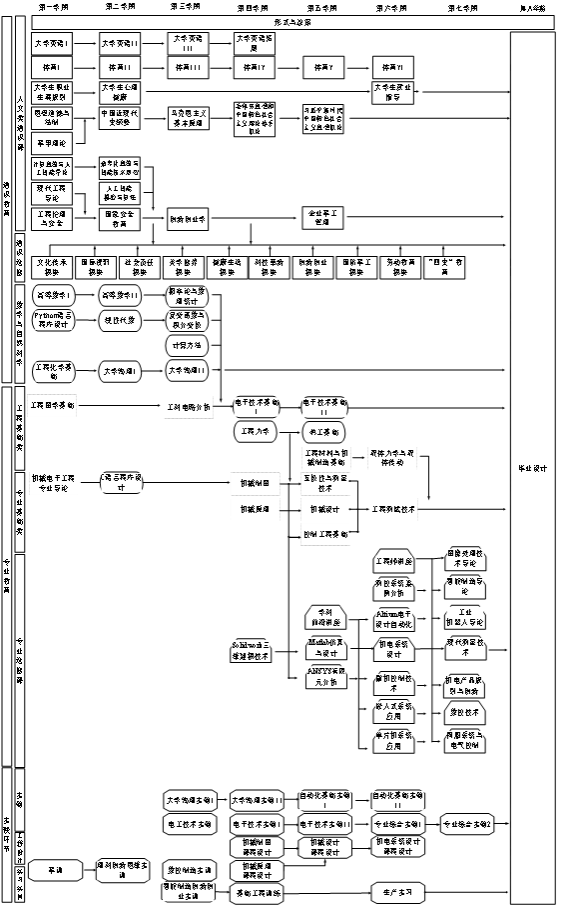
十一、培养方案对标情况表
XI. Benchmarking Form
培养方案与《国标》对应情况
|
国标要求 |
本方案 |
是否满足标准(是/否) |
总学分 |
150-190 |
176 |
是 |
数学与自然科学类课程学分(比例) |
15% |
16.8% |
是 |
人文社会科学类课程学分(比例) |
15% |
21.2% |
是 |
学科基础和专业课程学分(比例) |
30% |
36.4% |
是 |
实践教学环节学分比例 |
25% |
26.6%(含课内实验) |
是 |
选修课程学分比例 |
无 |
公共选修课3.9%;专业选修课5.3% |
是 |
核心课程 |
机械设计基础,机械制造基础,电路原理,工程电子技术,控制理论与技术,传感与检测技术,机电系统设计等知识领域 |
微机控制技术,机械制图,机电系统设计,流体力学与流体传动,机械原理,机械设计,控制工程基础,工程测试技术,电子技术基础Ⅰ(模拟),电子技术基础Ⅱ(数字),工程力学A,生产实习,智能制造创新创业实训,自动化基础实验II,机械制图课程设计,自动化基础实验I,机械原理课程设计,机械设计课程设计,机电系统设计课程设计 |
是 |
注:(1)国标中未规定的项目填写无即可。(2)“核心课程”一栏逐项罗列国标规定课程和方案中与之对应的课程。
培养方案与工程教育认证通用标准对应情况(工科专业必填)
|
工程教育认证通用标准要求 |
本方案 |
是否满足标准 (是/否) |
总学分 |
150-190 |
176 |
是 |
数学与自然科学类课程学分(比例) |
15% |
16.8% |
是 |
人文社会科学类课程学分(比例) |
15% |
21.2% |
是 |
学科基础和专业课程学分(比例) |
30% |
36.4% |
是 |
实践教学环节学分比例 |
20% |
21.7%(不含课内实验) |
是 |
选修课程学分比例 |
无 |
公共选修课3.9%;专业选修课5.3% |
是 |
核心课程 |
机械设计基础,机械制造基础,电路原理,工程电子技术,控制理论与技术,传感与检测技术,机电系统设计等知识领域 |
微机控制技术,机械制图,机电系统设计,流体力学与流体传动,机械原理,机械设计,控制工程基础,工程测试技术,电子技术基础Ⅰ(模拟),电子技术基础Ⅱ(数字),工程力学A,生产实习,智能制造创新创业实训,自动化基础实验II,机械制图课程设计,自动化基础实验I,机械原理课程设计,机械设计课程设计,机电系统设计课程设计 |
是 |
注:(1)专业认证标准中未规定的项目填写无即可。(2)“核心课程”一栏逐项罗列规定课程和方案中与之对应的课程。
专业负责人签字: |
王洪喜 |
教学院长签字: |
曹蔚 |
院教学指导委员会主任签字: |
尚雅层 |
校教学指导委员会主任签字: |
闫莉 |
时间:2025年6月18日

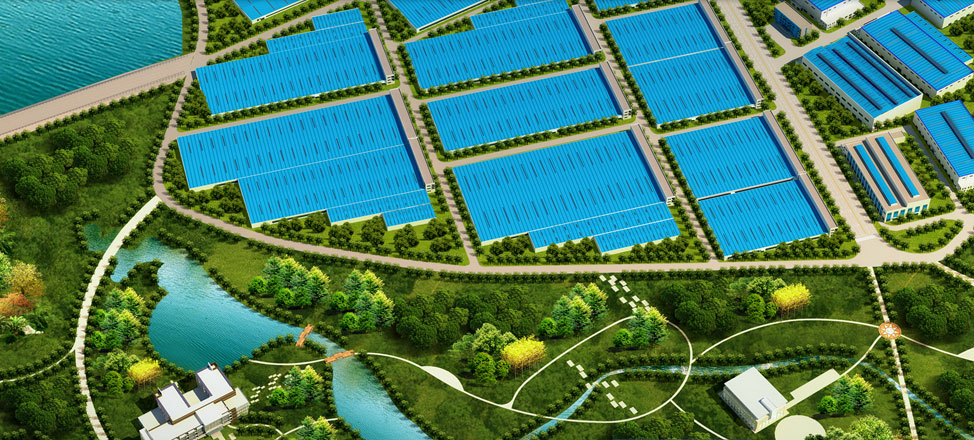



 快速链接
快速链接
 关注微信平台